By Renato Cudicio, President of TechNuCom
There comes a point in the life of many small and medium-sized businesses when a realization sets in. It’s no longer just about growth, hiring, or productivity. It’s about presentation.
When the time comes to prepare a business for a sale, many executives suddenly realize they need to “clean house.” Find the right numbers. Understand where the margins are. Reconcile inventories. Clarify processes. Document procedures. In short, get things in order before opening the door to potential buyers.
And that’s often where an ERP system really comes into its own.
Because before a sale, an ERP system like Odoo is a bit like the bride’s dress: it doesn’t create the business, but it does showcase it.
Before the sale, buyers want clarity
When a company is put on the market, buyers don’t just look at its revenue or order backlog. They want to understand what they’re actually buying. The due diligence phase is specifically designed to examine the company’s finances, operations, assets, legal issues, and prospects. The BDC also notes that a serious buyer will want to analyze the finances, assets, operations, and legal issues before proceeding further.
In this context, a company operating with scattered Excel files, software systems that don’t integrate, poorly documented processes, and contradictory data starts at a disadvantage. Not because it isn’t a good business, but because it’s hard to understand.
And what’s hard to understand becomes harder to sell.
Business succession is a game-changer in Quebec
This reality is also part of a much broader economic trend. In Quebec, business succession is becoming increasingly common, particularly because a large number of companies founded decades ago are reaching a turning point. The Chamber of Commerce of Metropolitan Montreal (ccmm.ca – article in French), citing data from Repreneuriat Québec, estimates that 50,000 business transfers are expected in Quebec by 2029. For its part, the Quebec City Chamber of Commerce and Industry notes that, on average, 3.9% of SMEs with employees change ownership and management each year.
In other words, in the coming years, tens of thousands of businesses will need to change hands, often because their founders are approaching retirement age.
In this context, structuring your business, ensuring data reliability, and streamlining processes with an ERP like Odoo is no longer just a matter of good management: it is also a very concrete way to facilitate the transition and present a business that is more solid, more transparent, and more reassuring to the next generation.
A well-structured business inspires greater confidence
Preparing for a sale isn’t about sugarcoating reality. It’s about making it transparent, consistent, and credible.
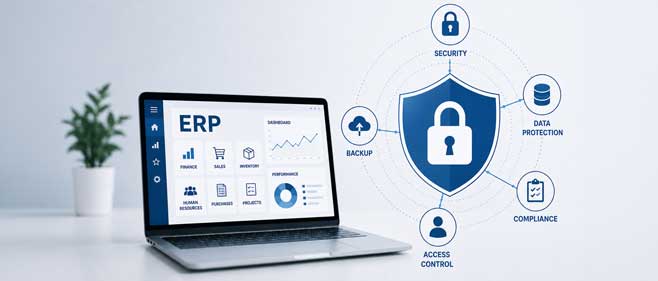
An ERP system allows you to centralize sales, purchasing, accounting, inventory, human resources, projects, and sometimes even customer service within a single environment. This is exactly the logic behind Odoo, which presents itself as a suite of integrated business applications covering the company’s main needs, from CRM to accounting, including inventory, sales, and project management.
In practical terms, this changes everything.
Instead of having three different versions of the same figure depending on which department you consult, you get a single source of truth. Instead of having to piece together a customer’s or an order’s history from emails, spreadsheets, and human memory, the information is already there—structured, time-stamped, and accessible. Instead of relying on two key employees who “know how it works,” the company begins to rely on a system.
And for a buyer, this difference is significant.
Odoo isn’t just for better management. It’s for better presentation.
We often talk about ERP as a management tool. That’s true. But from a transactional perspective, it’s also a tool for operational transparency.
A well-implemented ERP makes it easier to demonstrate operational stability, the quality of financial data, the traceability of inventory and orders, the actual—or lack thereof—dependence on certain employees, as well as the company’s ability to continue operating after a change in ownership.
In other words, it helps answer a silent question that all buyers ask themselves: Can this company stand on its own?
When the answer is yes, the tone of the discussion changes.
Getting Things in Order Before the Visit
It’s often in the months leading up to a sale that certain companies approach us. Not necessarily because they want to overhaul their entire organization. But because they feel they need to get things in order before moving on to the next step.
The symptoms are almost always the same. Data is out of date. Inventories are difficult to verify. Reports require too much manual work. Customer follow-ups are scattered. Procedures exist only in the minds of a few people. Accounting is accurate, but not always connected to the rest of operations.
Nothing insurmountable. But all of this becomes very apparent when a third party starts asking questions.
Implementing an ERP like Odoo then allows you to go far beyond mere housekeeping. It enables you to structure the business in a way that makes it easier to understand, analyze, and communicate.
A more attractive business… but also a stronger one
It would be simplistic to view ERP as merely a tool for pre-transaction valuation. In reality, the benefits begin long before the sale.
When data is better organized, decisions are made faster. When processes are centralized, errors decrease. When teams work within a coherent system, reliance on daily workarounds decreases. And when information flows more freely, management gains greater visibility.
This is, in fact, a recurring theme we’ve already addressed in our posts Which ERP for Your SME?, “More Tools Mean Less Efficiency,” and “Structuring Your Data to Work Better: The Benefits of an ERP.” The conclusion is always the same: a company that centralizes its operations becomes not only more efficient but also more transparent.
And in a sales context, transparency often equates to value.
Preparation that can also reduce friction during due diligence
Preparation on the seller’s side plays a central role in the smooth execution of a transaction.
The more the company is able to quickly produce reliable data, demonstrate the consistency of its operations, and explain its processes, the more smoothly negotiations proceed. This is exactly what buyers are looking for when they scrutinize a company during due diligence. The BDC also emphasizes that this step aims to review the company’s core areas to fully understand what is already in place.
Without claiming that an ERP system solves everything on its own, it makes the work much easier. Documents are easier to produce. Discrepancies are spotted faster. Records are better maintained. Gray areas diminish.
And above all, the company gives the impression of being in control.
Yet, in a transaction, control matters almost as much as performance.
Odoo: An Attractive Solution for SMEs Looking to Prepare Strategically
Not all SMEs need a massive project. This is also what makes Odoo particularly relevant in this context. Its modular design allows for the gradual implementation of the most critical functions, based on the company’s actual needs: accounting, inventory, sales, CRM, purchasing, manufacturing, projects, and human resources. The software provider itself promotes this integrated and modular approach, with applications that can be added as the company grows. See the Odoo applications.
In other words, it’s not always necessary to start from scratch. Sometimes, it’s enough to begin with the areas most critical to sales: data quality, traceability, financial visibility, and operational structure.
This is often where the difference lies between a company that seems complicated… and one that inspires confidence.
The bride’s dress, yes. But not just for the big day.
The image speaks volumes because it tells the truth.
The bride’s dress doesn’t change the person. It reveals, highlights, adds elegance, and underscores the solemnity of the moment. An ERP like Odoo plays a similar role when a company is preparing to be sold. It doesn’t replace strategy, results, or the quality of management. But it helps present the company in its best light. It gives it poise. It gives it structure. It gives it a coherence that buyers see right away.
And often, this begins well before the company is officially listed on the market.
If you feel your organization would benefit from getting its house in order before a potential transaction, now is likely the right time to discuss it. At TechNuCom, we support SMEs that want to structure their data, clarify their processes, and implement an ERP like Odoo in a practical, realistic way tailored to their specific context.
Because a company ready to sell is, first and foremost, a company in order.
And that takes preparation.
Are you considering a sale in the coming years? Let’s discuss it now.
Our team can help you get things in order before buyers start asking questions.